
















In the midst of World War II, revolutions didn’t only occur overseas, back home black Americans forced racial progress on their own.
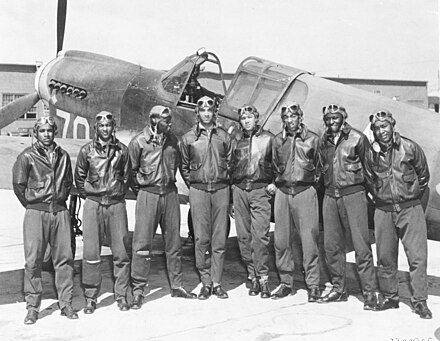
In January of 1941, the promise of a fresh start in the new year was established when the War Department announced the creation of an all-black 99th Pursuit Squadron. This would be the first in history, and the cadets began training in the following months at Tuskegee University in Alabama. Later down the road, in 1944 the group would be reconstructed into the 33rd Fighter Group, or the “Red Tails.” Unknowingly, these men would make history and break records, proving their worth in the U.S. military and pushing the country towards desegregation.
The young men, starting to gain recognition across the U.S., created a double-edged sword with their fame. On the field, the soldiers were praised for their war efforts where they carefully crafted plans that kept their bombers safe but left their enemies defenseless. Back home, this admiration didn’t translate.
The pilots faced extreme racists prejudice, denied entry into an officer club, a fight broke out that resulted in 103 officers arrested and charged. Despite the hatred forced upon them, the Red Tails persisted and worked hard until 1948, when President Truman abolished segregation the U.S. Armed Forces.
Today at Motion Field in Tuskegee, Alabama, the Red Tail’s story is told and experienced at the Tuskegee Airmen National Historic Site. With restored Hangers 1 & 2, including interactive exhibits, artifacts, and an aircraft, the park is free to the public and keeps history alive.
The Tuskegee Airmen received numerous honors for their bravery and excellence, including three Distinguished Unit Citations, 96 Distinguished Flying Crosses, 14 Bronze Stars, 744 Air Medals, eight Purple Hearts, and one Silver Star. In 2007, they were collectively awarded the Congressional Gold Medal, the highest civilian honor from Congress.